

The Complete Guide to Collecting and Caring for Artist Skateboard Decks
Baer & Bosch Collector Guides | Article 1, Part One
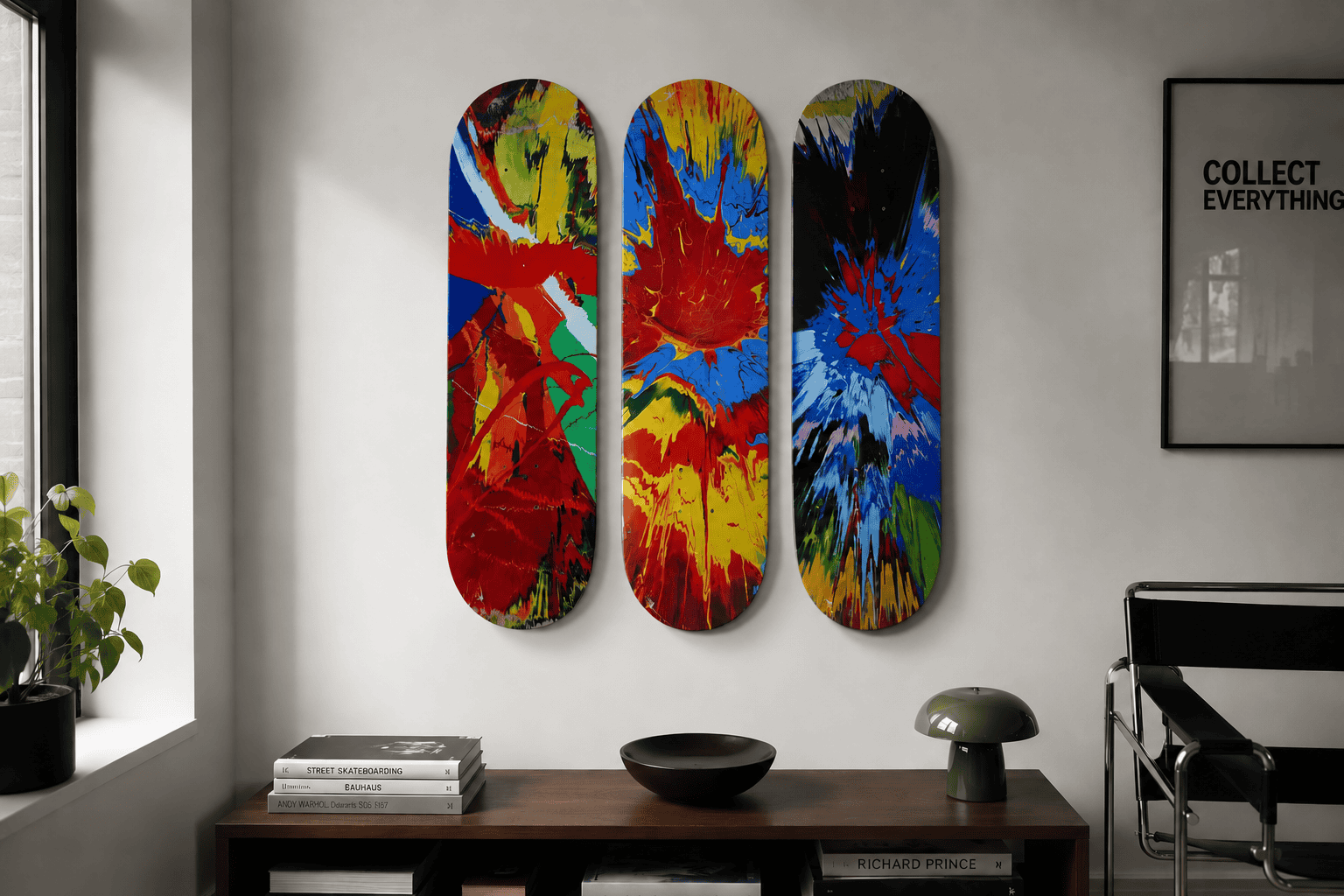
A matching set of artist skateboard decks displayed as contemporary wall art. Complete sets are often more desirable to collectors than individual decks.
Introduction
Artist skateboard decks have evolved far beyond their original purpose as sporting equipment. Today, they occupy a distinctive position at the intersection of contemporary art, graphic design, street culture, fashion, and collecting. Limited-edition releases by internationally recognized artists have transformed the familiar maple deck into a desirable art object displayed in private collections, galleries, museums, offices, and auction rooms around the world.
These works may be produced through collaborations with influential streetwear labels, art institutions, publishers, or established skateboard manufacturers. In each case, the deck functions as more than a surface for a reproduced image. Its shape, scale, material, and association with skate culture form part of the work’s meaning. Artist editions by Damien Hirst, Takashi Murakami, Cindy Sherman, Yoshitomo Nara, KAWS, Ai Weiwei, Jeff Koons, George Condo, Yayoi Kusama, John Baldessari, Jun Oson, Sean Cliver, Mike Kelley, and many others demonstrate how contemporary art has moved beyond conventional canvases and prints into collectible objects with their own visual language and cultural history.

Ai Weiwei artist skateboard decks displayed as collectible wall art. Image courtesy of Baer & Bosch Auctioneers.
Unlike skateboards purchased for riding, artist decks are commonly acquired for display, study, or long-term preservation. Some remain in their original shrink wrap or presentation packaging, while others are mounted individually or as complete multi-deck compositions. Their condition can change even when they are never used. Light may alter printed colorants, environmental fluctuations can place stress on layered wood and coatings, and unsuitable mounts may leave pressure marks or abrade an otherwise untouched surface.
Preservation has therefore become an important part of responsible collecting. As artist decks have entered more established art and design markets, buyers increasingly evaluate the same factors considered in other collecting fields: condition, completeness, edition information, provenance, authenticity, display history, and evidence of alteration. Care decisions made early in ownership can have a lasting effect on both the physical integrity of the work and the confidence of a future buyer.
This guide is intended for collectors, galleries, institutions, and anyone responsible for an artist skateboard collection. It explains how these decks are made, why certain examples become more desirable than others, and how preventive conservation principles can be adapted for private ownership. No preservation method can stop natural aging entirely, but informed handling, stable display conditions, thoughtful storage, and careful documentation can substantially reduce avoidable damage while maintaining the object’s originality for future generations.
Why Artist Skateboard Decks Have Become Serious Collectibles
Over the past several decades, collaborations among artists, skateboard companies, fashion labels, publishers, galleries, and cultural institutions have helped establish the skateboard deck as a recognized contemporary art format. The medium has an unusually broad cultural reach. It can carry the visual language of fine art while retaining associations with youth culture, streetwear, graphic design, and the history of skateboarding.
Collectors are therefore not purchasing only a functional object decorated by a familiar name. They may be acquiring a work that records a specific moment in an artist’s career, a landmark brand collaboration, or a period in which art and commercial culture intersected in a particularly influential way. The strongest examples often appeal to several collector communities at once, which helps explain why certain releases remain sought after long after their original issue.
Limited Production and Controlled Distribution
Many artist decks are issued in restricted quantities or for a limited period. Some are numbered editions, while others are unnumbered but were available only through a particular gallery, museum, retailer, event, or seasonal release. A small edition can support scarcity, but edition size should never be considered in isolation. A deck produced in greater numbers may command stronger demand than a rarer edition if the artist, imagery, collaboration, or historical context is more compelling to collectors.
Collector Insight
Scarcity and desirability are related, but they are not identical. An edition of 500 with broad, sustained demand may be more liquid and commercially valuable than an edition of 50 that attracts only a narrow audience. Collectors should examine both supply and the depth of the market.
Significant Artistic Collaborations
The category includes projects associated with major figures in contemporary art, photography, Pop Art, street art, and skate graphics. Relevant names include Damien Hirst, Takashi Murakami, Yoshitomo Nara, KAWS, Cindy Sherman, Ai Weiwei, Jeff Koons, George Condo, Yayoi Kusama, John Baldessari, Andy Warhol, Raymond Pettibon, Gilbert & George, Paul McCarthy, Mike Kelley, Albert Oehlen, Gabriel Orozco, Nobuyoshi Araki, JR, Futura, Erik Parker, Steven Harrington, Jun Oson, Sean Cliver, and others.
These releases differ considerably in intent. Some translate an existing artwork onto a deck, some create a continuous image across a multi-board set, and others emerge from an artist’s direct relationship with skateboarding or street culture. Understanding that context can help a collector distinguish a culturally meaningful collaboration from a product that merely reproduces familiar imagery.

JR’s “La Pyramide” triptych skateboard deck set. Image courtesy of Baer & Bosch Auctioneers.
Cultural Importance and Cross-Category Appeal
Artist decks sit comfortably within several collecting fields. They may be pursued by contemporary art collectors, streetwear enthusiasts, skateboard historians, graphic-design specialists, Pop culture collectors, and buyers of limited editions. A single object can therefore connect multiple histories and markets. This cross-category appeal has helped the format move from skate shops and seasonal product releases into curated exhibitions, specialist auctions, and serious private collections.
Cultural importance is not created by price alone. A historically significant deck may document an early collaboration, a now-iconic graphic, an influential exhibition, or a turning point in the relationship between a brand and an artist. Collectors who study the circumstances of release are better positioned to recognize importance before it becomes obvious through auction results.
Understanding How Artist Skateboard Decks Are Made
Preservation decisions are easier to make when the object is understood as a layered construction rather than a single piece of printed wood. The majority of conventional artist decks use laminated wood veneers, commonly maple, bonded under pressure and formed into a concave profile. Manufacturing methods vary, and collectors should avoid assuming that every deck uses the same wood species, adhesive system, coating, or printing process.
Maple Veneer Construction
Many high-quality skateboard decks are made from seven thin plies of maple, although the number and orientation of veneers can vary. The veneers are glued, pressed into shape, trimmed, drilled, sanded, sealed, and finished. Because wood is hygroscopic, it exchanges moisture with the surrounding air. Excessive or repeated environmental change can contribute to dimensional movement, distortion, stress within the laminate, or separation in vulnerable areas.
Screen Printing
Screen printing applies ink through a prepared mesh, usually one color or layer at a time. It can produce strong areas of color, crisp forms, and a tactile printed surface. The durability of an individual graphic depends on the ink, substrate preparation, curing, and protective finish. Even a well-made screen print can be scratched, polished unevenly, or altered by inappropriate cleaning.
Heat-Transfer Graphics
Heat-transfer processes are widely used because they can reproduce detailed imagery consistently across an edition. A printed transfer is applied to the prepared deck under controlled heat and pressure. The resulting graphic may be visually seamless, but its surface can still be vulnerable to abrasion, pressure, lifting at damaged edges, and changes caused by heat or unsuitable solvents.
Digital Printing
Digital printing allows manufacturers to reproduce photographic images, gradients, and complex color relationships without creating a separate screen for each color. The appearance and stability of the result depend on the ink system, preparation of the wood, curing method, and clear coating. Collectors should therefore judge the specific object rather than assuming that one printing category is inherently superior to another.
Protective Clear Coatings
A clear finish may enrich color, unify gloss, and offer limited resistance to handling and abrasion. It should not be treated as a permanent protective barrier. Coatings can scratch, become cloudy, change gloss, yellow, or react poorly to household cleaners. Once an original surface is polished, recoated, or locally retouched, the alteration may be difficult to reverse and can affect both appearance and value.
Why Construction Matters to Preservation
An artist deck combines several materials that may age at different rates: wood veneers, adhesive layers, inks, coatings, labels, shrink wrap, and sometimes presentation materials. A display method that is harmless to the wood may still abrade a printed surface. A storage environment that appears comfortable to a person may be too damp, too hot, or too changeable for a laminated organic object. Effective care therefore focuses on stability, clean supporting materials, minimal physical stress, and regular observation rather than on a single universal treatment.

A close up collection of skateboard decks showcasing unique designs and the creativity of skate culture. Image courtesy of Sonny Mauricio.
What Determines the Value of an Artist Skateboard Deck?
Rarity is important, but it is only one part of valuation. Auction specialists and experienced collectors consider the relationship among artist, edition, imagery, release history, condition, completeness, provenance, authenticity, and current market demand. Two decks from the same collaboration may achieve very different results if one retains its packaging and documentation while the other has fading, mounting damage, or uncertain ownership history.
Original Condition
Condition is among the strongest determinants of desirability. Collectors generally favor decks retaining their original finish, clear and undamaged graphics, crisp edges, intact factory-drilled holes, and a stable shape without moisture damage, delamination, structural repair, or obvious fading. Small chips, rubs, pressure marks, scratches, and edge wear may be commercially significant, especially when an edition is usually found in unused condition.
| What to Look For in an Original-Condition Deck |
|---|
| Original finish and surface sheen |
| Undamaged graphics and signatures |
| Clean, sharp edges |
| Factory-drilled mounting holes without enlargement |
| No significant warping or twisting |
| No moisture staining, mould, or swelling |
| No delamination or structural repair |
| No repainting, polishing, or replacement labels |
Original Packaging and Completeness
Depending on the release, original components may include factory shrink wrap, a protective sleeve, a presentation box, printed inserts, branded labels, a certificate of authenticity, or accompanying hardware. Retaining these elements can increase confidence and completeness, even when the packaging itself shows age.
Collectors should not assume that factory wrap must always remain sealed at any cost. Wrap may support an “unopened” description, but it can also trap dust, tighten around edges, become brittle, or change in appearance under heat and light. The decision to retain, open, or separately store packaging should be made conservatively and documented. High-value or unstable examples may justify advice from a qualified conservator before intervention.
Collector Insight
Never discard original packaging simply because it is creased, yellowed, or unattractive. Store it separately in a clearly labeled archival enclosure when it cannot safely remain on the object. Completeness and documentary value may matter even when the packaging is no longer suitable for display.
Edition Size and Scarcity
Numbered editions provide a clear production framework, but many important decks were not individually numbered. Scarcity can also result from restricted distribution, short release windows, regional availability, loss through use, or the difficulty of assembling a complete set. Collectors should distinguish between an officially documented edition size and estimates repeated in online listings.
Market Demand
Demand reflects more than the artist’s general fame. Collectors may respond strongly to a particular image, colorway, multi-deck composition, early collaboration, or brand association. Complete sets can attract buyers who would not pursue an individual board. Conversely, a highly limited release may remain relatively illiquid if the imagery or historical context has limited appeal. Recent asking prices should be treated cautiously; completed and verifiable transactions are more useful indicators of the market.
Provenance
Provenance is the documented history of ownership and transfer. For modern editions, it can begin with a simple retail receipt and become more substantial through gallery invoices, auction records, exhibition history, correspondence, or photographs showing the work at the time of acquisition. A coherent provenance file supports future cataloguing, valuation, insurance, and resale.
| Provenance Documentation Worth Retaining |
|---|
| Original retail receipt or order confirmation |
| Gallery or auction invoice |
| Certificate of authenticity or publisher documentation |
| Edition labels, serial numbers, or release inserts |
| Exhibition or publication references |
| Dated photographs showing condition at acquisition |
| Professional appraisal or condition report |
| Records of any conservation examination or treatment |
Authenticity
The growth of the category has increased the importance of careful authentication. Relevant evidence may include printing quality, dimensions, wood profile, manufacturer marks, labels, edition notation, packaging, release history, and comparison with documented examples. No single feature proves authenticity in every case, and counterfeit packaging can be as misleading as the object itself.
Before a significant purchase, collectors should compare the deck with reliable reference images and confirm that the seller’s account of the release is consistent with known facts. When uncertainty remains, an independent opinion from a recognized specialist, established auction house, publisher, gallery, or qualified authenticator may be appropriate.
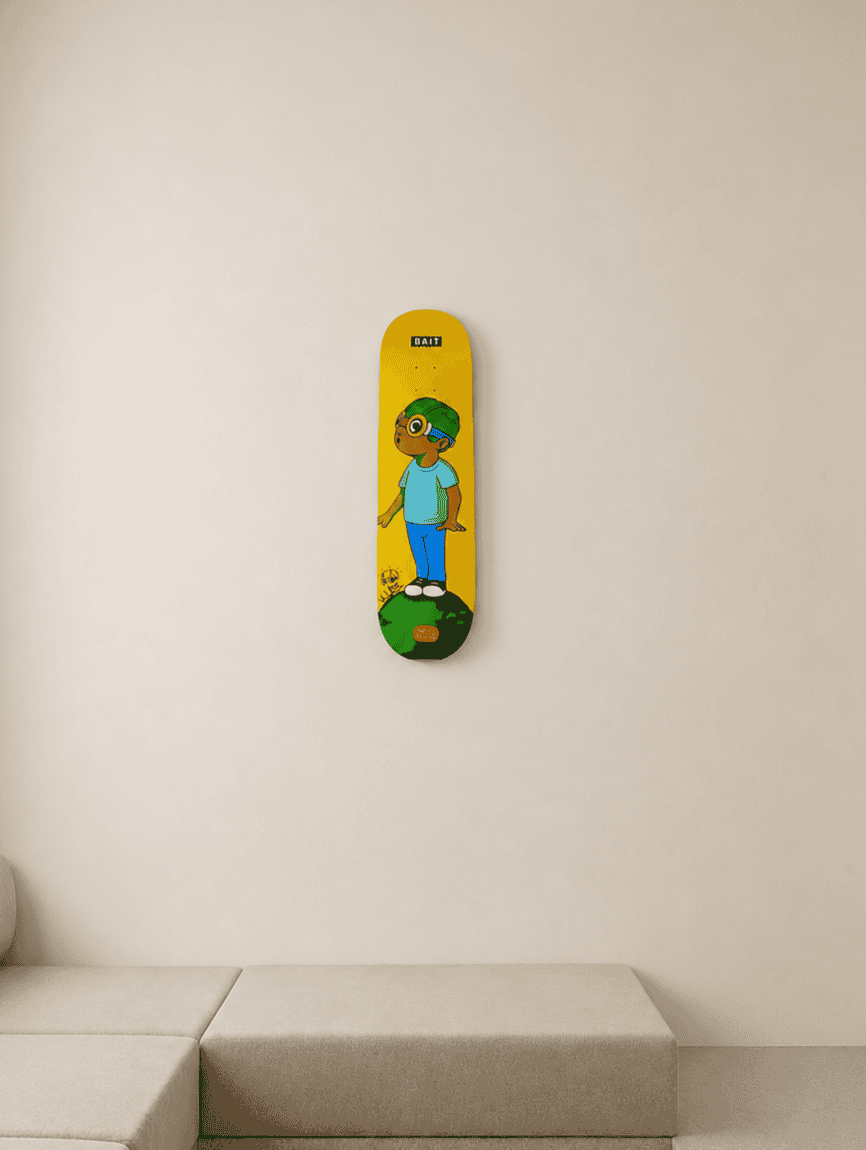
A colorful artist skateboard deck displayed as contemporary wall art.
Museum Principles Every Collector Should Understand
Professional museums and conservation laboratories approach collectible objects with a philosophy that differs significantly from cosmetic restoration. Rather than attempting to make an object appear new, conservators seek to preserve original material while slowing avoidable deterioration. Wood, adhesives, coatings, inks, labels, and plastic packaging all change gradually over time. These changes cannot be eliminated entirely, but preventive conservation can reduce the risks created by light, moisture, physical stress, pollutants, poor handling, and unsuitable storage.
The same principle should guide private collectors. The objective is not to return an artist skateboard deck to a factory-fresh appearance, but to protect the originality that gives the work its historical and collectible significance. Aggressive cleaning, replacement labels, refinished surfaces, repaired graphics, added hardware, or non-original coatings may diminish both physical integrity and market confidence. In many circumstances, stable evidence of age is preferable to an irreversible attempt at improvement.
Experienced collectors therefore place greater emphasis on prevention than on corrective treatment. Stable environmental conditions, careful handling, appropriate mounts, clean storage materials, detailed records, and periodic inspection are usually more effective than trying to reverse damage after it occurs. When treatment is genuinely necessary, the safest approach is normally the least invasive one capable of stabilizing the object.
The recommendations in this guide adapt established preventive-conservation principles for a modern mixed-media collectible. They do not replace object-specific advice from a trained conservator, particularly where a deck is signed, structurally unstable, affected by mould or moisture, or valuable enough that even a minor intervention could have significant consequences.

A carefully mounted multi-deck artist skateboard set, displayed as wall art. Image courtesy of Jean-Philippe Delberghe.
Where the Guide Continues
Understanding how artist skateboard decks are constructed, why particular editions become collectible, and which factors influence value provides the foundation for responsible ownership. Preservation, however, depends on the practical decisions made after acquisition. A rare deck can still suffer irreversible damage if it is repeatedly handled by its edges, displayed in direct light, mounted under uneven pressure, or stored in an unstable environment.
The next section of this guide will address the day-to-day practices that have the greatest effect on long-term condition. It will explain how to handle artist decks safely, select suitable wall mounts, manage light exposure, monitor temperature and relative humidity, protect factory packaging, and store individual boards or complete sets without placing unnecessary stress on the wood or printed surface.
Together, these measures form a practical preventive-care system. They allow collectors to enjoy and display artist skateboard decks while reducing the most common sources of fading, abrasion, distortion, and accidental damage.
Baer & Bosch Auctioneers is a specialty auction house for vintage and contemporary wristwatches, horological books, and collectible art. Consign with us at baerandbosch.com or browse upcoming auctions.